

How to test gold at home
How to test gold at home: The complete guide to identifying real gold
Gold is one of the most precious and sought-after metals in the world, and it has been used to make jewelry for thousands of years. However, it’s important to know that not every gold-colored piece of jewelry is made of real gold. The market includes gold-plated jewelry, gold-filled pieces, various alloys, and imitations—and sometimes it’s difficult to tell them apart just by looking.
Looking for real gold? Shop 14K gold jewelry (58.5% gold) from our collection:
If you own a piece of jewelry and want to find out whether it’s made of real gold, there are several at-home tests that can provide an initial indication. However, it’s important to know that a professional assessment by a jeweler or laboratory is the most accurate method.
Browse high-quality gold jewelry:
14K gold jewelry ↗
14K gold chains ↗

What does karat (K) mean in gold?
Pure gold is 24 karat (24K), but it is very soft and therefore unsuitable for most jewelry. For this reason, it is mixed with other metals to create a stronger alloy.
Common karat ratings:
-
24K — pure gold (99.9%)
-
22K — nearly pure gold
-
18K — high quality
-
14 karat — the most common in jewelry
-
10K — lower gold content
Most gold jewelry has a small hallmark indicating its karat rating.

Is a gold hallmark proof?
Not necessarily.
Although genuine gold jewelry usually bears a hallmark (such as 14 karat or 585), there are also cases of fake hallmarks or gold-plated jewelry with misleading markings.
So, a hallmark is an indication—but not definitive proof.
How to test gold at home — common methods
1. Magnet test
Gold is a non-magnetic metal.
How to test:
-
Take a strong magnet
-
Hold it close to the jewelry
-
If the jewelry is attracted, it is probably not pure gold
Note: Jewelry clasps are sometimes made of a different metal and may be attracted to a magnet even when the piece itself is gold.
2. Water float test
Gold is a very dense metal, so it sinks in water.
How to do it:
-
Fill a glass with water
-
Place the jewelry in the glass
Result:
-
Sinks — it may be gold
-
Floats — not gold
This is only a basic test and is not conclusive.
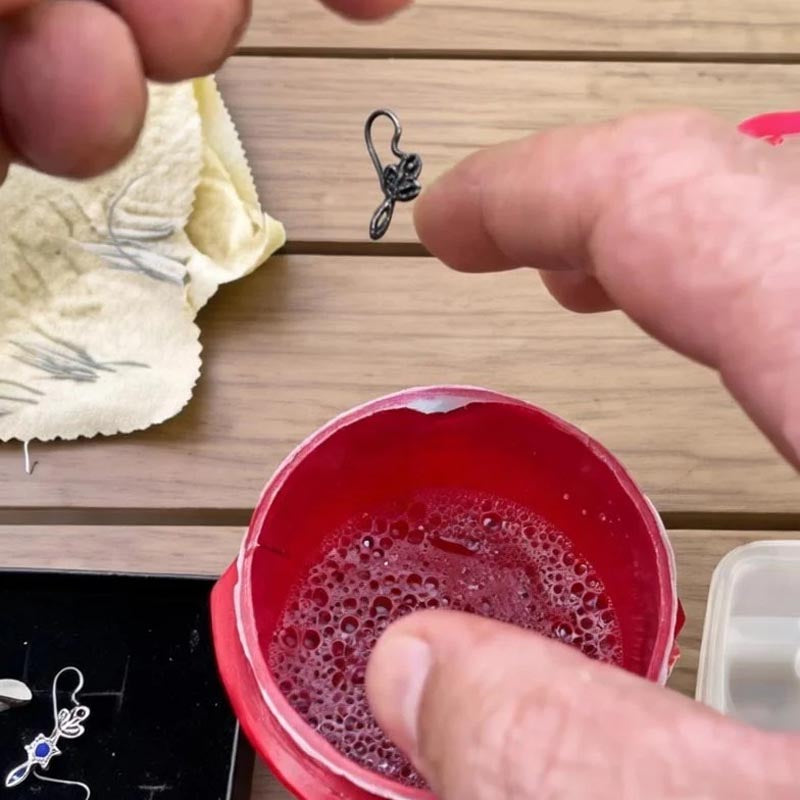
3. Vinegar test
Gold does not react to vinegar.
How to test:
-
Put a little vinegar on the jewelry
-
Wait a few minutes
Result:
-
Color change — not gold
-
No change — it may be gold
You can also soak it for a few minutes and rinse it with water.
4. Skin mark test (makeup)
A well-known but less scientific test:
-
Apply liquid foundation to your skin
-
Rub the gold over the area
Real gold may leave a dark mark.
However, this is not a completely reliable test.
What is the most accurate way to test gold?
Have it tested professionally by a jeweler or laboratory.
Professional methods include:
-
A dedicated acid test
-
Density testing
-
Electronic testing
-
XRF (X-ray testing that does not damage the jewelry)
This is the only way to know the gold content for certain.
Types of jewelry that look like gold—but aren’t solid gold
It’s important to know about:
-
Gold-plated jewelry
-
Gold-filled jewelry (a relatively thick layer of gold)
-
Gold-colored alloys
-
Brass
-
Other plated metals
That’s why it’s important to know how to test it.
Examples of genuine gold jewelry

Why is it important to know if gold is genuine?
Because gold is a financial investment.
Proper testing helps you:
-
Understand the jewelry’s value
-
Avoid counterfeits
-
Make sure you’re paying a fair price
-
Protect your investment
What do the numbers in a hallmark mean?
Gold jewelry from Europe and Israel usually has a three-digit hallmark. The number indicates how many parts out of 1,000 are pure gold. This is the quickest way to understand what you’re holding:
| Hallmark | Karat | Pure gold content |
|---|---|---|
| 375 | 9K | 37.5% |
| 417 | 10K | 41.7% |
| 585 | 14K | 58.5% |
| 750 | 18K | 75% |
| 875 | 21K | 87.5% |
| 916 | 22K | 91.6% |
| 999 | 24K | 99.9% |
The hallmark is usually found on the chain clasp, on the small plate next to it, inside a ring, or on the pendant’s bail. Use a magnifying glass or your phone camera’s zoom.
Codes that indicate plating
Some markings look like gold hallmarks but actually indicate that the piece is not solid gold:
| Marking | Meaning |
|---|---|
| GP | Gold Plated: a thin layer of gold over another metal |
| GEP / HGE | Electroplated gold |
| RGP | Rolled Gold Plate: a thin rolled layer of gold |
| GF | Gold Filled: a thicker layer, but still not solid gold |
| 925 on gold-colored jewelry | 925 silver with gold plating, not gold |
| 14K GP / 18K HGE | The karat refers to the plating only |
If you see "14K" on a piece of jewelry priced at just a few dozen shekels, you're almost always looking at plating. We explain this phenomenon in depth in our guide to how plating is sold to you at the price of gold.
Density test with a kitchen scale
This is the most accurate at-home test, and it won't damage the jewelry. Gold is very heavy for its volume, so you can calculate its density using an accurate digital scale (0.01 grams) and a glass of water:
- Weigh the jewelry dry and write down the weight.
- Place a glass of water on the scale and tare it.
- Lower the jewelry into the water, suspended by a thin thread, without letting it touch the sides or bottom. Write down the number displayed: this is the volume of water it displaced.
- Divide the dry weight by the second number.
| Result (grams per cm³) | What it probably is |
|---|---|
| 19.3 | 24-karat gold |
| 15.2–15.9 | 18-karat gold |
| 12.9–14.6 | 14-karat gold |
| 10.3–10.5 | 925 silver |
| 8.4–8.7 | Brass or plated metal |
Example: A chain weighing 3.9 grams that displaces 0.29 grams of water has a density of about 13.4. This is consistent with 14-karat gold. For very lightweight jewelry, under one gram, a kitchen scale isn't accurate enough, so the test only gives you an indication.
Ceramic tile test
Gently rub a hidden corner of the jewelry against the unglazed back of a ceramic tile. Real gold leaves a gold-colored streak. Plated metal or brass leaves a dark or black streak. Important: this test leaves a small scratch, so don't do it on new jewelry or jewelry that isn't yours.

An unbelievable price is a warning sign
Gold is a commodity traded on the stock exchange, so it has a price floor. To give you a sense of scale: a thin 45 cm 14-karat yellow gold box chain costs ₪599 at our store, and a 45 cm Spiga chain costs ₪899 (prices as of October 2026). A "14K gold" chain of the same length priced at ₪80 isn't a bargain. It's plated.
How we label gold
All the 14-karat gold jewelry on our website is made of solid 14-karat gold, not plated, and each product page lists the material and dimensions. For our gold photo-engraved pendants, you can choose the gold weight and karat (14, 18, or 21).
Frequently asked questions
Is real gold attracted to a magnet?
No. But a clasp, spring, or core made of another metal may be attracted, so a magnet alone isn't proof.
Is a 585 stamp absolute proof?
It's a strong indication, not proof. Combine it with a density test and a reasonable price. For complete certainty, consult a jeweler with an XRF analyzer.
Does 14-karat gold tarnish?
14-karat gold doesn't tarnish like silver. Sometimes it can look dull from cream or sweat, but this comes off with lukewarm water and soap.
What's the difference between white gold and yellow gold of the same karat?
The amount of pure gold is the same. The difference is in the other metals in the alloy, and white gold is usually also plated with rhodium for a bright white finish.
When do you need a professional test?
At-home tests provide an indication, but there are cases when it's better not to rely on them: inherited jewelry you want to sell, buying an expensive item secondhand, or jewelry that seems too heavy or too light for its size. A jeweler or lab can test it with an XRF analyzer, which identifies the metal composition without damaging the jewelry, or use an acid test on a touchstone. The test takes just a few minutes and usually costs little compared with the value of gold jewelry.
When buying new, the most important test is choosing the seller: a store that lists the material, karat, and dimensions for every product and offers returns is a store with nothing to hide.
White, rose, and yellow gold: how do you test them?
All the methods in this guide work for every gold color. White and rose gold of the same karat contain the same amount of pure gold as yellow gold; the only difference is the other metals in the alloy. Note that white gold is usually rhodium-plated, so the streak on a tile may appear grayish. That's normal and doesn't indicate a fake.
Summary
Real gold can be identified using several at-home methods—magnets, water, vinegar, and stamps—but none of them is completely accurate. The surest way to know is to have it professionally tested.
When you buy jewelry from a reliable source, you can be confident in the quality and authenticity of the gold.
Browse our gold jewelry collection:
14-karat gold jewelry ↗

Leave a comment
This site is protected by hCaptcha and the hCaptcha Privacy Policy and Terms of Service apply.